LAND WITHOUT A NAME
In 1932 Czech writer and journalist Ivan Olbracht used this title for a book about the province of Ruthenia (now part of Ukraine) that had been incorporated into the newly created Czechoslovak state. A remote territory of woodcutters and farmers, Ruthenia lacked a name, in Olbracht’s view, because it was subject to so many competing nationalist claims. Throughout central Europe, the “land” had symbolized an imagined bedrock of pure and unified national character since the nineteenth century, though in reality it represented a complicated overlay of ethnicities, languages, and religions.
Photography, like writing, served to “name the land,” to disseminate a fictive, harmonious image of the landscape and its occupants. Homeland Photography (Heimatphotographie in German) developed into a widely recognized and state-supported movement throughout the region in the 1930s to suit this nationalist embrace of the countryside. One significant representative of Homeland Photography, Wilhelm Angerer, produced dramatically cropped and retouched images of the Austrian Alps, offering a rhapsodic interpretation of traditional subject matter using distinctly modern pictorial methods. As the territorially rapacious Third Reich laid claim to ever more places in 1930s Europe, such work took on an increasingly heavy symbolic charge. Some landscape photographers echoed Nazi ideology outright or implicitly; others turned to the land in foreboding or resignation, having surmised the disaster to come.
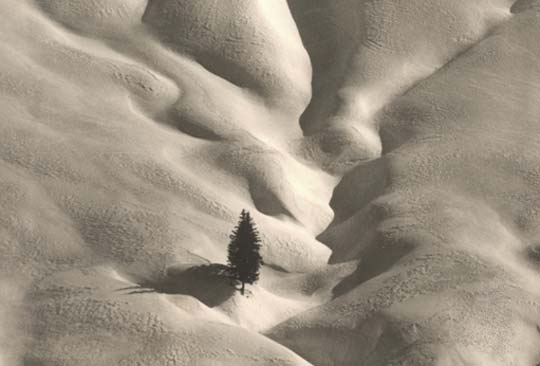
Wilhelm Angerer, A Winter Song, 1933–1945 (detail) - view full image
- The Cut-and-Paste World: Recovering from War
- Laboratories and Classrooms
- New Women — New Men
- Modern Living
- The Spread of Surrealism
- Activist Documents
- Land Without a Name
- The Cut-and-Paste World: War Returns